Grief
Grief is the human response to loss. Loss most often refers to death, but also includes profound change: diagnosis, divorce, moving, loss of independence, or the slow disappearance of a relationship to dementia. Grief is love with nowhere to go.
Grief isn't one emotion. It can show up as sadness, anger, numbness, guilt, relief, exhaustion, or even brief moments of joy that then bring shame. There isn't a correct timeline or sequence.
Grief as Waves
Many people describe grief as waves— powerfully crashing in without warning at first, slowly becoming less frequent and less intense over time, but never fully stopping. With anniversaries, a familiar smell, a song on the radio, or a favorite food, the wave arrives with its emotions: sadness, anger, numbness, guilt, relief, exhaustion, or even laughter.
This is one of the most shared and loved descriptions of grief ever written—a Reddit comment from 2011 by u/GSnow, written to a stranger asking for help. Fifteen years and millions of readers later, it still holds up.
Taking Care of Yourself
"Grief brain" is real. It's that heavy, exhausted feeling where even small decisions feel impossible. When your brain is this busy navigating loss, you have to prioritize the essentials: sleep, food, water, fresh air, and movement. Here are four things worth keeping in mind:
Take it easy
Grief takes enormous energy. Saying no to obligations, asking for help with logistics, and scaling back expectations of yourself makes a ton of sense. Give yourself permission to rest or do what brings you comfort, whether that's taking a walk, napping, or watching a favorite movie.
It's okay to not be okay
Feeling wiped out, crying a lot, feeling nothing at all, full of rage, or just unlike yourself are all normal responses to loss. There's no right way to grieve, and no timeline you should be meeting. Grief doesn't follow a schedule, and however you're experiencing it is valid.
Sharing stories helps
Talking about who you lost: their life, their stories, and what you miss is one of the most natural ways to process loss. This can be anyone in your community, and it's most helpful when that person (or people) are active, nonjudgmental listeners.
You don't have to manage this alone
It takes a village, lean on your community. A grief counselor or therapist can help if things feel unmanageable. Warmlines offer free, non-crisis emotional support by phone or text. And if you're ever having thoughts of self-harm, please know that support is there too: call or text 988.
Per the Medicare hospice conditions of participation, bereavement support must be made available to the family if your loved one was on hospice for 13 months after the death. Additionally, hospices are required to provide community resources to anyone who is grieving.
Comforting a grieving friend
Most people who want to help a grieving friend don't know what to say—and so they avoid it, or say something that unintentionally minimizes the loss. Presence matters far more than the right words.
What helps
- “I've been thinking about you.”
- “I don't know what to say, but I'm here.”
- “Tell me about them.”
- Showing up with food, childcare, or practical help
- Saying the person's name out loud
- Texting on anniversaries and hard dates
What to avoid
- “They're in a better place.”
- “At least they lived a long life.”
- “I know how you feel.”
- “Everything happens for a reason.”
- Comparing their loss to yours
- Going quiet after the funeral
Keep showing up and listening after the first few weeks, when the casseroles stop and the world expects “normal” to return. That's often when grief is hardest and support has thinned out.
Grief and Time
Time behaves differently after a loss. It can feel like an eternity has passed since you last saw them, yet simultaneously feel like it just happened five minutes ago. This isn't you losing your mind—it's your brain trying to reconcile a world that looks the same but feels fundamentally different.
Days like anniversaries of a death, birthdays, and holidays can be heavy times where grief is very present. Flagging these days on your calendar isn't about bracing for pain—it's about managing your limited energy.
Make a loose plan
Decide ahead of time what you'll do on the date. If you make plans to be with others, give yourself permission to leave early. Tell them: "I'd love to come, but I might not stay long depending on how I'm feeling."
Lower the bar
There's no correct way to spend a hard day. Whether it's visiting a favorite spot, looking at photos, or staying in bed with a movie, give yourself permission to ignore the world's expectations of "normal" - and your own expectations too.
Growing around grief
A helpful way to think about grief comes from grief counselor Lois Tonkin, who noticed something that didn't fit the standard model: many of her clients said their grief never really shrank. What actually happened wasn't that grief got smaller—it was that their life grew around it. New experiences, relationships and meaning accumulated around the grief, without replacing or erasing it. The grief stayed the same size. The life got bigger.
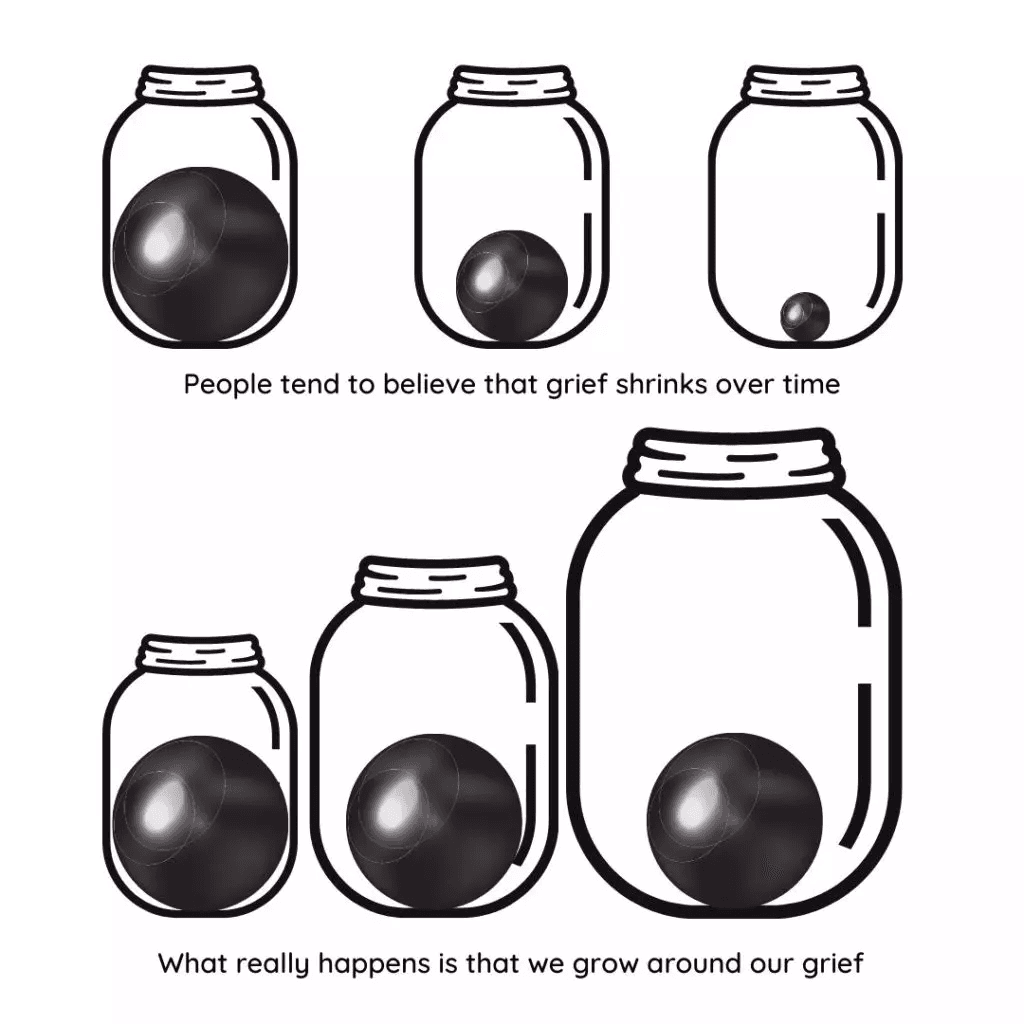
Image credit: The Ralph Site
This reframe matters practically: you don't need to wait for grief to shrink before living. Growing your life—new routines, connections, moments of joy—isn't a betrayal of loss. It's what moving forward actually looks like.
The “5 Stages” misconception
You've probably heard of the five stages of grief: denial, anger, bargaining, depression, acceptance. They're everywhere—but they're widely misunderstood. Elisabeth Kübler-Ross developed them in her 1969 book On Death and Dying to describe what terminally ill patients experienced as they faced their own deaths. They were never intended to describe what bereaved people go through after losing someone else.
Kübler-Ross herself later said the stages were never meant to be a rigid sequence and regretted how they had been applied. Grief research since then has consistently found that most bereaved people do not move through these stages in order—or at all.
Using the 5 stages as a grief roadmap can be useful — it names real, common experiences. However, knowing they were never meant as a sequence for grief after loss may take some pressure off.
Worden's Tasks of Mourning
Grief therapist J. William Worden proposed a more useful framework: a task-based model that treats mourning as active work, not passive progression through feelings. Unlike the 5 stages, tasks don't have a fixed order, you can return to them, and they can be helpful signposts for how grief is showing up in individual moments.
Accept the reality of the loss
Moving from intellectual knowing to a deeper emotional acceptance that the person is gone.
Process the pain of grief
Allowing and working through the feelings—not pushing them away or getting stuck in them.
Adjust to a world without them
External adjustments (roles, routines), internal adjustments (identity), and spiritual adjustments (meaning).
Find a lasting connection
Remembering and carrying your loved one with you as you re-engage with life — moving forward with them, not away from them.
Source: J. William Worden, Grief Counseling and Grief Therapy (1982, updated 2018)
Other kinds of grief
Grief isn't only what happens after a death. Several other forms are common—and often go unacknowledged.
Anticipatory grief
Grief that begins before the death through a terminal diagnosis, a long decline from dementia, or the slow loss of someone to illness. The losses are real along the way, and grief arrives to meet them.
Secondary losses
The losses that cascade from the primary one. This can refer to identity (as a parent, spouse, friend), daily routine like getting groceries, financial stability, date nights that are no longer possible, or even a role as a caregiver.
Disenfranchised grief
Loss that isn't socially recognized or validated—the death of a pet, a miscarriage, an estranged parent, a friendship, or a relationship others didn't know about. The grief is real even when the world doesn't make space for it.
Complicated grief
Now called Prolonged Grief Disorder, this is when grief remains severely debilitating well beyond what's typical — intense longing, difficulty accepting the loss, or inability to engage in daily life. Unlike depression, it responds to specialized treatment. If this sounds familiar, seek out a therapist who specializes in PGD specifically.
More specialized resources
While grief has many universal themes, some paths are deeply specific. These communities and resources are organized by situation, format, and type of loss.
Specific situations
- Child Loss: The Compassionate Friends — Dedicated support for families who have lost a child of any age.
- Pregnancy & Miscarriage: I Had a Miscarriage: A Memoir, a Movement, Share Pregnancy & Infant Loss Support — Dr. Jessica Zucker's memoir and manifesto for navigating this often-silent loss, and a national peer support network for families across the full spectrum of pregnancy and infant loss.
- Loss to Suicide: SAVE, Friends for Survival, AFSP — Specialized peer support and resources for those who have lost someone to suicide.
- Pet Loss: Lap of Love — Specific support and resources for those grieving a companion animal.
Violent or sudden loss
- MADD: Mothers Against Drunk Driving — Provides free emotional support and victim advocacy, 24/7, for those impacted by impaired driving crashes.
- POMC: Parents Of Murdered Children — A vital national community for survivors of homicide victims, providing support that general grief groups often can't match.
- TAPS: Tragedy Assistance Program for Survivors — Though military-focused, their peer-based model for navigating sudden, traumatic loss is widely considered one of the most effective bereavement programs in the country.
Grief for kids & teens
- The Dougy Center — A national leader in providing support for children, teens, and young adults.
- Experience Camps — Incredible summer camp programs and year-round resources for grieving children.
- Moving In Forever — Rebecca Wu's children's book on love, loss, and family.
Further Listening
- All There Is with Anderson Cooper — A deeply moving exploration of loss, featuring guests including Stephen Colbert, Sara Bareilles, Patti Smith, and more.
- GriefCast — Cariad Lloyd's podcast that manages to be both funny and devastating while talking to people about their experiences with death.
- Terrible, Thanks for Asking — Nora McInerny's podcast about loss, change, and the things we don't say out loud. One of the most honest and widely loved grief podcasts out there.
Further Reading
- As Long As You Need: Permission to Grieve — J.S. Park, a veteran hospital chaplain, offers you both the permission and the process to grieve at your own pace.
- Griefstrike — Jason Roeder's book for those who appreciate dry humor as a survival mechanism — a witty look at grief's absurdities.
- It's OK That You're Not OK — Megan Devine's highly recommended book written from her experience losing her partner suddenly.
You don't have to carry grief alone. If you want a listening ear or help finding next steps, we're here.
Get in Touch